How can a retail shoe store make money with the transition to VAT?
So, changes to tax legislation have become a reality today. The VAT rate has increased from 20% to 22%. Effective 2026, the government has lowered the income limit for operating under the simplified tax system (STS) and patents. As a reminder, the income limit for the STS excluding VAT has been reduced from 60 million to 20 million rubles. Many footwear businesses that previously operated under the simplified tax system will transition to the new system this year, becoming VAT payers. Owners are faced with the question of how and where to cover additional costs. SR expert Evgeny Danchev, who specializes in increasing shoe retail sales, examines this challenging situation and offers recommendations on how to avoid losing profits. Given declining customer traffic in retail stores, rising taxes, and overall costs, the most effective way for a retail company to increase margins is to increase the trade markup, the expert believes.
 Evgeny Danchev -
business coach, consultant, expert in increasing sales of the fashion market. Author of the book "A Practical Guide to Increasing Sales of Shoes and Accessories". Author of sales scripts "60 responses to customer objections in a retail shoe store" and "Standards for retail shoe sales." Creator of an online school for fashion market leaders.
@evgenydanchev,
https://onlineschool.wconsulting.su/
Look at your business's sales statistics and consider why you initially set your markup at a certain figure; why, for example, do you add a 150% or 200% markup to the cost of goods?
Ask yourself the following questions:
1. What are these trade margin figures based on?
2. How does this trade margin take into account the company's increasing costs (marketing, rent, taxes, wages)?
3. Can the trade margin be the same for several years, or should it change?
4. How can the optimal trade margin level be determined for a retail business, and what criteria can be used to set it?
A common limiting belief among managers is: “I can’t increase my retail prices by increasing my markup because my competitors will sell the product at a lower price and I will lose some of my customers and revenue.”
In fact, this phrase precisely explains the internal mechanism by which managers decide on retail pricing. Every business owner experiences two basic emotions during the process of setting it:
1. Fear
The owner fears losing revenue due to higher prices than the market average. For some reason, price becomes a more important criterion for managers during competitive analysis. They are terrified of the possibility of their product being sold at a higher price than similar or identical products from competitors.
Although price is only one selection criterion, what about service, sales associate performance, merchandising, bonus or discount programs, current promotions, and the company's overall market image?
I always have one important question for business owners: why, when they buy shoes at exhibitions, do they select them so carefully, trying on each model, evaluating its convenience, comfort, appearance, the materials from which it is made, but when it comes to sales and setting a trade markup, all these criteria fade into the background, and the price comes first, and it is always no higher than that of the competitors.
Over the past 12 years, I've worked as a business consultant with shoe retail chains in various countries (Russia, Moldova, Kazakhstan, Estonia, and Latvia), and we conducted competitive analysis for each business. This analysis yielded real statistics on the overlap between the client's product line and those of their main competitors. The share of identical products (exactly the same model or similar alternatives) was no more than 10%.
Therefore, when salespeople explain their failure to meet sales targets by retelling customer claims that competitors have the same models at lower prices, they must keep in mind the true percentage of similar products. They mustn't lower retail prices based on only a small percentage of such models.
There's nothing wrong with a small portion of your store's inventory being more expensive than your direct competitors. Why? I'll answer the same way I do when I look salespeople in the eye who constantly complain about high prices: if the prices on shoes and bags are always lower than the competition, then why even bother with salespeople on the sales floor? What added value will they provide to the customer? You could reduce your staff and leave one person in the store who will simply fetch the right size from the warehouse and run the receipt. And this person won't be a salesperson, just a cashier and stocker.
What's the difference between a salesperson and a cashier? A salesperson must use sales techniques, one of which is handling objections. Often, price objections arise for a simple reason: the salesperson doesn't know their product well. The customer, meanwhile, doesn't see the difference in the product and says, "Your price is too high." In essence, they're aleatherg for clarification on why they're paying 10-20% more than they would at the store next door.
And here the question isn't about the product's price, but rather what the seller knows about it and how they can present it. What competitive advantages does the product offer, what distinguishing features does it have, and what benefit does the customer receive by paying more at the checkout than at the store next door? This is how added value is created in the eyes of the customer.
Therefore, the fear of higher prices for goods than competitors is just fear and an excuse for sellers to protect themselves from their own incompetence.

1. Greed (in the good sense of the word) is the second emotion that influences the decision-making of managers regarding the formation of retail prices.
Businesses are created to generate profit, generate income, and therefore, "not selling too cheaply, or earning as much as possible" is what drives owners to invest their time and energy. Of course, everyone wants to buy cheap and sell expensive. But in practice, it doesn't always work that way.
Over the past few years, I've observed the following situation in some shoe businesses: at the start of the sales season, merchandise is offered at the first price, or with minimal discounts for loyalty cards. But sales plans are not met with this approach, inventory levels are slowly depleted, and store revenue is insufficient to cover the ordering of new collections. The owners explain the lack of promotions this way: "Why should I offer discounts or run promotions? The product is new and good; people should buy it even without discounts. I don't want to get customers used to discounts."
When the sales season arrives, cash flow gaps arise, cash is in dire need, and owners decide to sell off remaining inventory at steep discounts (up to 50%). As a result, customers still end up buying most of their collections on sale and at the maximum discounts.
For clarity, I ask the company for statistics on the collection's sales share by month (in pairs of shoes). For example, from September to December and from January to February. It happens that out of 100% of all pairs of shoes sold during these six months, 40% are sold from September to December, and 60% from January to February. Can this sales ratio be considered effective? More likely no than yes.
So, over four months, the company sells only 40% of its pairs for the fall-winter season at a high markup. And 60% of its pairs are sold at a low markup. Not a very effective strategy.
This is how healthy greed manifests itself in managers. They're unwilling to compromise, don't conduct marketing campaigns to stimulate sales, and then rush to sell off the product at a minimal markup, just to avoid having to keep it for the next season.

Having analyzed how two basic emotions work at the psychological level during the price formation stage, we can draw the following conclusion: the price of shoes and accessories can be formed according to two main principles.
The first is a low-price strategy that eliminates the need for a large number of sales assistants and added value. Under this strategy, only large discount chain stores can survive in the current market conditions. The 2026 tax law changes will have the least impact on them, as they are already VAT payers and operate with high turnover. A 2% VAT increase will have virtually no impact on their operations. The most significant threat to such businesses is not the tax changes, but rather the decline in store traffic. Discount stores must maintain high turnover; if it begins to decline sharply, increasing their markups will not prevent them from operating at a loss. A more appropriate strategy for this category of businesses would be to carefully optimize costs, including closing unprofitable stores and reducing staff.
The second principle of retail pricing is based on added value; accordingly, the level of service and merchandise in such stores is higher. Many businesses in this category will transition to the new tax system in 2026, becoming VAT payers (previously, they could operate under a simplified tax system).
And here, owners are faced with the question of how and where to cover additional costs. The answer can be found by analyzing two price elasticity curves of demand.

In the graph on the left, we see elastic demand, which means revenue increases as retail prices decrease. In the graph on the right, we see inelastic demand, which means revenue decreases as retail prices decrease.
When the Western model of end-of-season promotions and sales began to be widely adopted in Russia about 15 years ago, the graph on the left worked well. But in recent years, the graph on the right has increasingly worked well as well. Price reductions through discounts don't always lead to revenue growth. The explanation is simple: when a product's price is reduced due to a discount, the total receipt amount also decreases. This can only be offset by increasing the number of sales or increasing the complexity of the receipt (the number of items per receipt). And since all companies offer discounts, it's not always the case that more customers visit the store during a promotion or sale. If incoming traffic doesn't increase, it's possible that the store's revenue will even be lower than before the promotion. This doesn't mean promotions don't work or that they're unnecessary; it's just that to effectively implement them, a marketing campaign must be conducted in advance, in parallel with the sale, to inform potential buyers (in marketer parlance, "increase reach"). And this always entails additional marketing costs, which the company may not necessarily allocate.
A typical example comes from online business. In 2025, not all companies selling shoes and bags on marketplaces were profitable. The marketplaces themselves regulated retail prices, requiring suppliers to participate in promotions, sometimes lowering markups below 100% of cost. The increase in the number of purchases and turnover only led to higher logistics costs, marketplace commissions, and reduced sellers' margins. The result of this work was enormous disappointment among retailer managers in this sales channel and a trend toward developing their own online stores.
Given declining customer traffic in retail stores, rising taxes, and overall costs, the most effective way for a retail company to increase margins is by increasing its markup. Store traffic is declining not only in Russia, but also in Kazakhstan, Latvia, and Moldova. With declining traffic, increasing markups is the only way to generate more revenue and cover company costs. Additional costs should be passed on to customers rather than attempting to undercut competitors.
Why is the Central Bank of Russia reducing its key rate so slowly (in December 2025, it was reduced by only 0,5%)? Because the regulator understands that businesses will factor the VAT increase into retail prices, increasing trade margins. Fearing this, the Central Bank is taking a conservative approach to unfreezing inflation-control mechanisms.
To further support the argument that increasing trade margins is appropriate in the current market conditions, I'll share a case study from business practice. Analyzing the performance of a retail shoe chain for the spring-summer 2025 season, I saw a 26% year-on-year change in the average price per item (comparing 2024 and 2025). At the same time, total store revenue increased by 5%. The increase in the price per item was largely due to offering customers significantly smaller discounts at the end of the season than the previous year, and running promotions from the very beginning of the sales season. I'd like to emphasize the difference between discounts and promotions. At the end of the sales season, a direct discount on a product significantly reduces the trade margin and its price. A promotion at the beginning of the sales season (for example, a discount on only the second item on the receipt) doesn't significantly reduce the markup. Ultimately, a balance was achieved between the emotions of fear and greed, which allowed for a significant increase in the price per item.
What does this case study tell us? In 2025, customers were purchasing shoes at 26% higher prices than in 2024, yet the company's revenue didn't decline, but rather grew by 5%. Of course, the company didn't limit itself to simply reducing discounts. Changes were made to the management system and incentives for in-store salespeople, which, taken together, produced this result.
These data completely contradict conventional economic theory, which holds that higher retail prices lead to a decline in sales. In my experience, this isn't the first time an unconventional approach to sales has yielded results. It's essential to consider the global changes occurring in retail businesses' cost structures and respond to them promptly. Today, it's impossible to achieve positive sales results using yesterday's strategies. Managers need to change their approaches to understanding the financial and economic analysis of their businesses.
An increase in trade margins is inevitable. The exact amount to increase them should be determined on a case-by-case basis, taking into account the company's tax system. However, given inflation in Russia, a minimum increase of 5-7% is reasonable.
It's especially challenging right now for businesses that sell branded goods at recommended retail prices (RRPs). Low markups, limited marketing campaigns, and rising costs are hitting their owners hard. How can they grow and make money in these conditions?
In this situation, constructive dialogue is needed with the majority of sellers and the brand's supplier. A consolidated discussion on the markup, taking into account the growth of the taxable base, can be undertaken, and a position on increasing the RRP can be defended using facts and figures.
Also, if the franchise agreement does not provide for the sale of products from other suppliers, it is necessary to discuss permission to expand the product range with new, higher-margin products.
How to avoid over-purchasing goods?
What's really going on with retail managers?
Effective methods that will help improve the effectiveness of sellers
How to open an effective store of shoes and accessories. Success formula
Budget but attractive. How to get a store window right and bright with a limited budget
 Shoes Style and its Discoveries. An Interview with Anton Bazylev, Prize Winner of the International Shoe Design Competition
The international shoe design competition Shoes Style, held in Moscow this year, showcased many interesting footwear and accessory collections. Shoes Report recently published a story about the winners—third-year students from Kosygin Russian State University, Margarita Skvaznikova and Egor Lysov, who presented their "Retrospective" shoe collection at Shoes Style.
 ICEBUG at Euro Shoes: Swedish Innovation in Grip Technology
ICEBUG is a Swedish company steeped in innovation and creativity. Our rapid growth is a result of our expertise in grip and technology. Since its inception, ICEBUG has been creating footwear with superior grip and is always striving to improve grip even further.
 KV+ will present versatile sneakers for both sports and urban wear at Euro Shoes.
The Swiss brand KV+ is not so well known to the general Russian audience, but it is well known in the world of skiing, because it was there that KV+ took its first steps and actively developed. The Swiss brand has earned the trust of the professional sports audience over the past 35 years. At the same time, the Russian sports market of ski equipment has always been a priority for the Swiss.
 Rieker and Remonte are regular exhibitors at Euro Shoes: meet your favorite brands at the exhibition from August 25 to 28 at the Central Trade Fair Center.
Riker and Remonte will present their Spring/Summer 2027 collections at the Euro Shoes exhibition (August 25–28, WTC Congress Centre).
 New brands at Euro Shoes in August!
At the end of the month, from August 25th to 28th, the international footwear and accessories exhibition Euro Shoes Premiere Collection will take place in Moscow at the WTC Congress Center on Krasnopresnenskaya Embankment. We'd like to introduce you to the new exhibitors at Euro Shoes, who will be presenting their collections of footwear, accessories, shoe care products, and leather goods.
 From July 27 to 29, the Euro Shoes@CAF_Eliteline 2026 exhibition will be held in Almaty, Kazakhstan.
Elite Line is an international specialized exhibition of footwear, fur, leather, and accessories. The exhibition will feature collections from international and domestic manufacturers from Russia, Turkey, Germany, Italy, Kazakhstan, and other countries.
 How to learn to effectively manage store customer traffic?
Customer traffic in shopping malls and street retail is declining; people are shopping less offline for a number of objective reasons, one of which is the convenience of online shopping with all its advantages. And yet, offline shopping continues to thrive. How can we control store traffic, learn to correctly calculate and influence the number of people visiting stores to ensure profitability?
 "When Customers Are Few: How Fashion Store Owners Can Squeeze the Most Out of Every Customer"
In recent years, offline retail in clothing, footwear, and accessories has been operating under conditions of a steady decline in incoming traffic. By the end of 2025, offline store traffic in Russia had declined by 8-15%, with the offline segment's purchase rate declining more sharply than the overall market, according to Retail.ru. According to statistics from individual shopping centers, the decline by the end of last year was between 15 and 25%. How can salespeople effectively engage with customers in such challenging conditions? We'll explore service strategies in low traffic conditions with SR expert Elena Vinogradova, who specializes in purchasing and sales in the fashion business. The expert shares proven methods with practical examples of speech modules. Elena is confident that, in a context of declining traffic, high-quality service is becoming the main competitive advantage for the shoe industry.
 How the Masters Forge. Interviews with the Winners of the International Shoe Design Competition, Shoes Style
In May 2026, the finalists of the international footwear design competition, Shoes Style, were awarded again in Moscow. The annual competition is held by A.N. Kosygin Russian State University, a university that trains shoe designers and technologists, and attracts students from design universities in Russia and the CIS.
 How to sell more without losing customer trust?
Today, discounts and sales are no longer considered an effective tool for achieving sales targets. Furthermore, online and offline stores offer consumers virtually the same price for shoes, and consumers often choose not the cheapest option, but the easiest and fastest one. This is why service and soft sales are becoming a key competitive advantage for shoe stores, says Maria Gerasimenko, an expert at SR in fashion business management and development.
 Euro Shoes: the industry's leading footwear exhibition will be held August 25–28 at the WTC Congress Center.
At the end of August, Moscow will once again become a magnet for the footwear industry: the WTC Congress Center on Krasnopresnenskaya Embankment will host the international exhibition Euro Shoes Premiere Collection—a specialized B2B event for footwear industry and fashion retail professionals, the key industry event of the new purchasing season and the development of fashion retail assortments. Over 100 companies and brands will participate in the exhibition, presenting their spring/summer 2027 collections of shoes, bags, and accessories to professional visitors. A working meeting of the National Footwear Union of Russia (NOBS) will be held as part of Euro Shoes, featuring footwear companies, professional associations, marketplaces, and independent experts.
 The share of marketplaces will grow
The footwear category on Ozon Fashion shows steady growth
The share of online sales in fashion is growing, and last year it was already more than 54%. Buyers are increasingly buying clothes and shoes online, and the lion's share of these purchases are made on marketplaces. Ozon is one of the leading players in the Russian fashion market, and the Fashion direction on the platform is the fastest growing. About trends in online trading, about the specifics of the shoe market and recommendations for brands planning to sell shoes through the marketplace - in an exclusive interview with SR with the Commercial Director of the Footwear direction at Ozon Fashion Olga Moskvicheva.
 What factors influence pricing, and how to work with retail prices for shoes
Footwear retail is one of those segments that is highly dependent on seasonality. Pricing in the footwear business, in turn, depends on a multitude of factors, from production costs to the vagaries of weather and regional factors.
SR's expert in product assortment and management, Emina Ponyatova, discusses the key principles of pricing footwear products, as well as the main pressure factors and challenges facing footwear retailers in 2025, and offers recommendations on how to ensure successful and profitable retail.
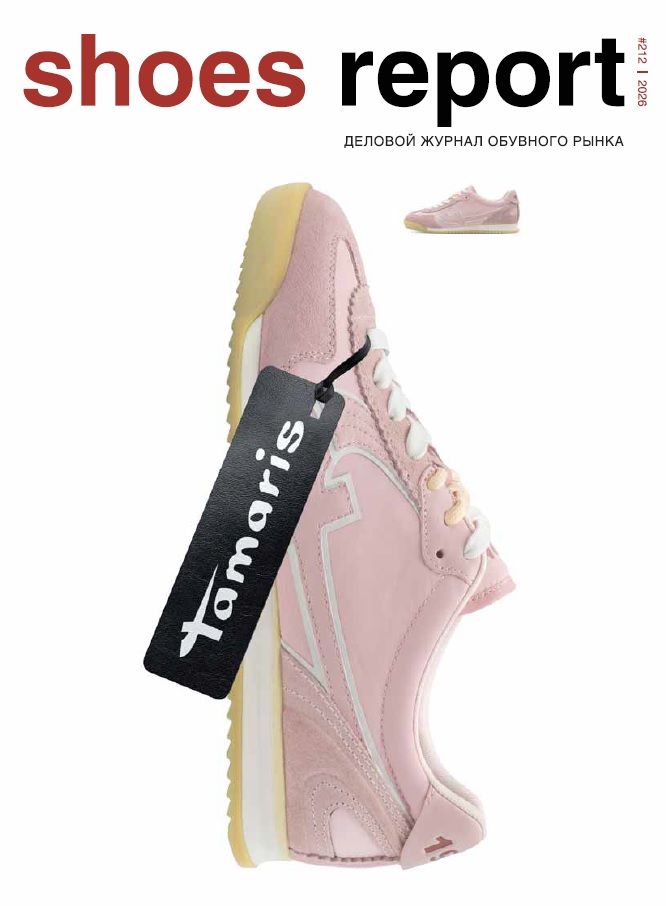
 New Tamaris Spring-Summer 26 Collection: Comfort and Elegance in Every Model
German footwear and accessories brand Tamaris will present its new Spring-Summer '26 collection at the Euro Shoes exhibition in Moscow, from August 27 to 30.
 Creating an emotional connection through a showcase
Emotional response from customers is the key to successful retail sales. Shop windows are capable of not only attracting attention, but also evoking emotions: from joy and nostalgia to a sense of belonging and the desire to possess. Using psychological triggers in shop window design helps turn a passerby into a buyer. SR expert in visual merchandising and retail design Viktor Malygin talks about approaches to the concept of shop window design and current themes and plots for presenting goods in shop windows.
 MARCO TOZZI presented his Fall-Winter 2025/26 collection in Moscow.
A harmony of comfort and elegance, fashion trends and classic essentials—German shoe and bag brand MARCO TOZZI presents its new Fall-Winter 2025/26 collection.
 Euro Shoes starts on August 27th!
The leading international exhibition of footwear and accessories in Moscow, Euro Shoes premiere collection, starts next week!
 Euro Shoes: The Fall Premiere That Set Trends and Raised Acute Questions for the Industry
From August 27 to 30, Moscow once again became the shoe capital: the international exhibition Euro Shoes premiere collection was held in the congress center of the Central Trade Fair on Krasnopresnenskaya Embankment. For four days, the exhibition brought together leading global brands, buyers and industry experts, becoming a place where fashion trends are created and business alliances are formed.
 Three fashionable colors for accessories and shoes for the fall-winter 2025/26 season
Each season, trend bureau Future Snoops (formerly Fashion Snoops) identifies key colors for different product groups. For shoes, bags, and accessories, the forecast takes into account the specifics of the categories and is based on general cross-market color forecasts for the season. The three colors described in the article below will influence the accessories market in the fall/winter 25/26 season, helping you promote trendy new items and update classic styles. These shades have beautiful and delicious names: "Ice Star," "Honey Glaze," and "Cherry Jam."
 Euro Shoes — March 4-7, 2026 at the WTC Congress Center
From March 4th to 7th, leading brands from Europe, Asia, and the CIS will gather at the WTC Congress Center in Moscow to present their Fall/Winter 2026 collections, capture current trends, and set the direction for the fashion industry.
 Customer profiling in a shoe store. What is this technique and how can it be used in sales?
Profiling is a scientific method of "reading people," allowing one to create a psychological profile of a person and predict their actions or behavior in certain situations, or even catch them in a lie. Profiling is used in sales because the salesperson needs to understand a person's emotional state and their underlying motivations for purchasing. An expert and practitioner in sales growth in fashion, SR, discusses this method and its practical application in footwear retail.
 Shoe educational program: what shoe soles are made of
“What is the difference between TEP and EVA? What does tunit promise me? Is PVC glue? What is the sole of these shoes made of? ”- the modern buyer wants to know everything. In order not to smash his face in front of him and be able to explain whether such a sole suits him in soles, carefully read this article. In it, process engineer Igor Okorokov tells what materials the soles of shoes are made of and what makes each of them so good.
 How to set prices that will earn
Some businessmen still confuse the concept of margin with the concept of trade margins and set prices for their goods, guided solely by the example of competitors. No wonder they go broke! Analyst at the Academy of Retail Technologies Maxim Gorshkov gives several tips and formulas with which you can set not only ruinous, but also profitable prices.
 Sales of shoes and accessories: effective techniques for business rhetoric
Which speech modules are effective in communicating with potential and current customers of shoe stores, and which are not, Anna Bocharova, a business consultant, knows.
 We form the salary of sellers: expert advice
“How do you charge your consultants for personal or general sales?” Is one of the most popular questions causing a lot of controversy and gossip on the online forums of retail business owners. Indeed, how to properly form the earnings of sellers? But what about bonuses, where to get a sales plan from, do employees allow them to buy goods at discounted stores? In search of truth, the Shoes Report turned to a dozen shoe retailers, but no company wanted to disclose its motivation system - the process of its development was too complicated and individual. Then we asked four business consultants, and finally became convinced that the topic of seller motivation is very complex, because even our experts could not come to a common opinion.
 The whole truth about Bayer. Who is he and how to become one?
Bayer is no longer a new, but still a popular and sought-after profession. It’s fashionable to be a buyer. Buyers are at the origins of the emergence and development of trends. If the designer offers his vision of fashion in the season, then the buyer selects the most interesting commercial ideas. It is on buyers that the policy of sales of stores and what, in the end, the buyer will wear depends on. This profession is surrounded by a magical fleur, often associated with a lack of understanding of what exactly is the work of a buyer.
 Technology Selling Issues
There is nothing worse than meeting the buyer with the words “Hello, can I help you with something?”, Because the seller works in the store just to help. Criticizing this well-established pattern of communication with the buyer, Andrei Chirkarev, business coach for effective sales and the founder of the New Economy project, shares the technology of truly selling issues with readers of Shoes Report.
 Fur, and not only: types of lining
In the production of winter footwear, various materials are used that are designed to retain heat and meet the requirements of consumers: natural sheepleather, artificial fur, artificial fur from natural wool and others. All types of lining fur have their own advantages and disadvantages. Let's consider the properties of each of them.
 The best models of Czech shoes of the past
In Soviet times, for shoes from Czechoslovakia sold under the Cebo brand, customers stood in line for four hours and did not regret it, because Czech shoes were considered to be of high quality, comfortable and fashionable. Shoe designer Juraj Shushka shared a photo archive of his collection with Shoes Report magazine, which contains the most interesting Cebo models from the 1940's to the 1980's.
 Retail Arithmetic
Before you begin to solve specific problems, you need to find out how accurately all the leaders of your company understand the basic terminology of retail.
 How to fire a worker without tears, scandal and trial
Sooner or later, any manager is faced with the need to part with an employee. Correctly and on time the dismissal procedure will save the company money, and the boss himself - nerves and time. But why sometimes, knowing that a break in relations is inevitable, we postpone the decision for months?